
Late Summer Update
Late Summer, 2010,
Friends and Family,
Veraison is complete. Veraison is the change of color and texture of the berries from green and hard to purple and soft. It is the end of the growth cycle and the beginning of the ripening process. (See The Oxford Companion To Wine, Jancis Robinson, 3rd edition, Oxford University Press. It is the best reference book available and can be found on Amazon, used books, for about $30-$35. Worth every penny!).
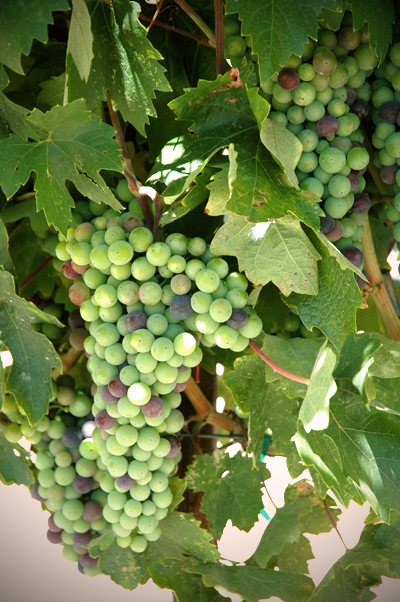
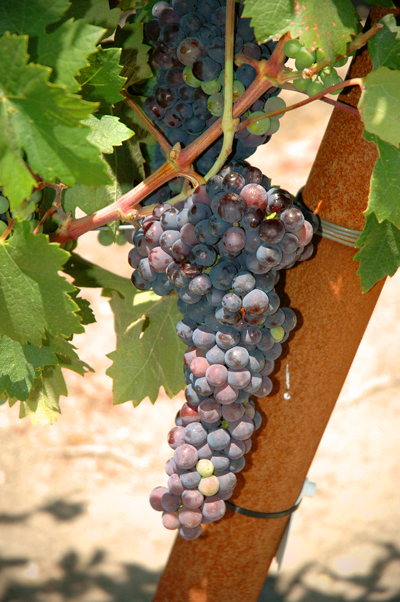
We finished our pruning by dropping the unevenly ripened fruit and have winnowed about half our Zinfandel and about one third of the Syrah and Cabernet Sauvignon. Our Zin plants produced enough fruit to weigh in at 10-15 pounds per plant. We have culled to produce about eight pounds and will harvest about five pounds. Just the very perfect and concentrated fruit. The Syrah and Cab were on track to produce between 6-8 pounds per plant. We will pick about four pounds per plant…just the best of the best.
Brix (ratio of sugar to water in the berries) and pH (acidity. we aim for 3.2-3.6) are changing every day, but, s-l-o-w-l-y. We expect to harvest the Syrah first, in about two weeks, Cab in three weeks and Zin in early and mid October.  Our last to harvest will be a limited production (25 cases, and only in extraordinary years) Zinfandel, Block 1, Rows 1, 2 & 3.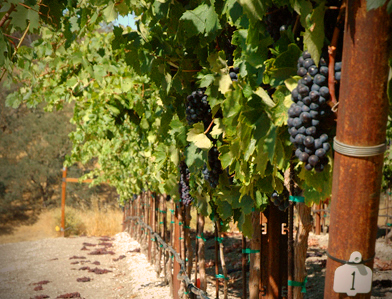
These vines have been tended differently. We exposed the fruit of rows 1, 2 & 3 to more direct sunlight in their early development and then shaded them with a second growth canopy. We pruned the berries and bunches which were “burned” or over ripened. We gave the plants more water in the spring and early summer and have been cutting back since mid June. We will not water these rows from now on. All these efforts are to encourage early ripening and then a slow build up to a high Brix count 28-30%. We will then put this wine on a heavily toasted, Hungarian, half oak barrel. (Toasting is the process of applying heat to the insides of a barrel. The heat chemically alters the composition of the staves reducing tannins. Lesser tannins produce a “rounder,” smoother, finish to the wine.) Our goal is to produce a big, fruit-forward wine, much like Helen Turley’s Zins produced in Paso from 1995-2005 and Chris Pisani’s early (pre 2000) Zins for ZD.
A late October harvest risks rain. Zin berries are very tightly clustered and will not dry out easily when rain water seeps in between them. They rot. This work of farming requires a delicate balance and a little bit of luck. Keep your fingers crossed.
A surprising number of you have asked to be part of the harvest. I’ll try and give you a two day notice. All hands will be appreciated. But be forewarned, I am a tough taskmaster…no long stems, no leaves and no dirt!!! Just perfect clusters.
More to follow regarding harvest, fermentation and racking.
Salut La Famiglia,
Joseph and Anita
Summer Update
The grapes and vineyard look absolutely splendid! The past winter’s rains have created a healthy abundance of fruit. Our careful prunings over the winter and into early spring have paid dividends…handsome, upright and sturdy shoots.
I have chosen to early prune — that is, to thin the leaf cover in front of the fruit but to leave a full canopy to overhang the exposed clusters.
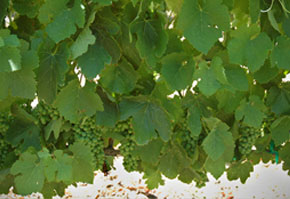
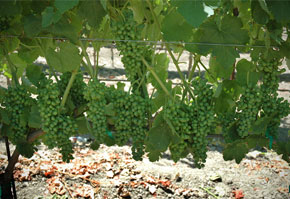
The first two photos show a before and after. They are of the same vine. You can see the leaves pulled to expose to the sun and the canopy trimmed to create shade between 1-3 o’clock in the afternoon. Look at the third photo and you will see what has been removed, including dropped fruit. This trimming, removing of unwanted fruit and creation of a canopy takes about 2 1/2 to 3 hours per row. Thirty-four rows, 1,317 plants!
We will harvest no more than 4-5 pounds per vine, or about 6-8 clusters. Each plant now holds an average of 12-18 clusters. We will drop more fruit after the clusters turn purple, culling those clusters which have not ripened well or unevenly. This “green drop” will occur in about a month. In late August/early September we will drop the “worst of the best” to get us to our 4-5 pounds per vine yield.
(Technical Aside) We plant approximately 1,000 vines per acre. 4-5 pounds per vine translates to 2-21/2 tons per acre. Very low yield, very intense flavors.
I will “trim” the vines each week and modify the watering program depending on berry growth and temperature. This week will be the hottest so far this year. We have had unseasonably cool temperatures this spring and early summer. But this weekend, and early next week, we will see 100-107!! Remember, we cool down at night to 55. A 50+ degree swing. The grapes love it!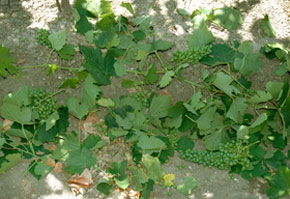
I’ll send out more updates as we work our way toward harvest. Please send me any questions or requests you have.
Now some business matters. Two things:
Firstly, PLEASE sign in on our website with your mailing address (snail mail) and telephone number. This is the only way you can become a member of our wine club. ONLY WINE CLUB MEMBERS will be able to purchase our wines. There is no obligation to buy but you must be a member.
Secondly, many of you commented on the story about how “George’s Blend” came to be. The saga continues.
I am delighted to tell you that both his beautiful daughters will be married this summer, to men George would be proud of. Our “library” of “George’s Blend” is getting low but you can bet we will toast his children’s future with the wine he inspired and helped to make…”salute la famiglia.”
Take care,
Anita and Joseph
Frost is past
Friends we are, i hope, beyond the threat of frost so i will do some light pruning today. i’ll remove duplicate shoots and shoots below the cordons. some clusters are beginning to form. Most of these will be “dropped” and only about 1 cluster per cane will be allowed to ripen. This culling will insure the highest quality fruit from our vineyard.
Salute,
Joseph
Pruning Vines for the Winter
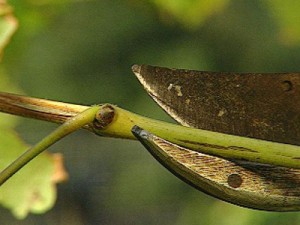
Why Trim?
Trimming is important because it stimulates growth of the vines and product. You want to remove buds that suffer freeze damage. Also, too many grape bearing vines will weigh the main vine down and cause it to break. Too much weight on the vines might also cause the wire to break or drop, which would result in loss of product in the long term and create more work replacing wires the next season.
When to Trim
According to Curtis Smith from the agriculture extension of New Mexico State University, some people trim in autumn, but this could lead to freeze damage because the trimming will stimulate growth and if there is a late autumn warm-up the newly formed buds will die. It’s important to leave them unpruned through early winter to protect the plants through the natural process of apical dominance. Apical dominance means that the buds at the ends of the vines have priority of growth, so if they start to form buds and then freeze, trimming them off will stimulate growth on the younger buds that grow at the top of the vines (Smith). The trimming should be completed before spring and especially before the last few frosts. Waiting too long to trim will leave you more susceptible to damaging buds. Also, it is important to trim after the first frost, but don’t trim if the temperature is way below zero because this will also damage the plant.


